
Existentialism Philosophy

Dasein for Authentic Conservatives
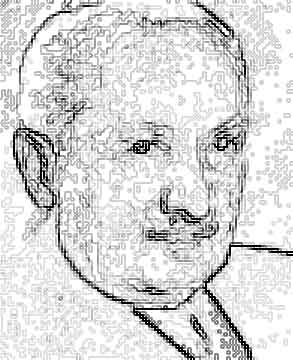
For individuals who are sincere in searching for authenticity, confronting their own prejudices is an essential step. The standard to determine if those propensities are valid, must answer the question: "is it so"? Attempts to reach an exegesis of life, needs to rely upon honesty about the texture of one’s own life and the spiritual nature that underpins our existence. Heidegger offers an insight that can be applied to the real world of politics.
If you need a quick refresher course on Martin Heidegger, start with the concept of "Dasein". "Dasein translates as "being-there". So, according to Heidegger, before anything else we exist, we are "there", we are in the world and that is how we should conceive ourselves if we are going to understand our lives. To stress the importance of this existence, Heidegger gave to Dasein’s activity of existing, the term being-in-the-world. The use of the hyphens emphasizes that there is no distance between ourselves and the world. We are as much a part of that world as it is part of us. The "in" is precisely an indicator of involvement, Heidegger thought that no distance, either physical or mental, should exist between ourselves and the world. Dasein’s interest and involvement with its world is intrinsic to Dasein. There is no existing, no "being-there", without a world in which to exist. A person without a world makes no sense. The world and Dasein are one and the same."
Those who identify with traditional values understand the combative makeup of realpolitik. Conservatives who are firmly grounded in authentic heritage are viewed as the last remaining threat to the triumph of the secular world. Liberals devote much of their energy and all their esteem in the pursuit of denying the lessons of history and the universality of the corrupt nature of man. Being-in-the-world means to them, that conforming to the will of the popular culture is the highest homage. Opposing the sacred cows of the sanctioned order is a risky endeavor. However, the path for authenticity is both ecumenical and personal, at the same time.
In "Being and Time" Heidegger, uses the term Dasein as a depiction for mankind. Jacob Graham offers the following assessment: "Dasein is 'fallen' into the world of what Heidegger calls the 'hey-self'. The world of the 'they' is the world of everyone and yet no one in particular. Heidegger states that Dasein exists inauthentically within this world. In the fundamental ontology that Heidegger takes up, there is no evaluation of Dasein's inauthenticity as 'bad' or 'good', or as being worse than authenticity. Heidegger, in Being And Time, has simply taken up the task of a fundamental ontology to get at the primordial roots of Dasein. The fact that Heidegger found Dasein's existence to be, for the most part, inauthentic, does not hold evaluative elements in a fundamental ontology."
The moral element for conduct is absent in the void that is the common plight of man. For Heidegger, according to Mr Graham: "We find that alienation is not alienation from anything (object) in the world, but Dasein is alienated from itself. Moreover, we see that this alienation is not a kind of separation of Dasein from itself, but is an 'entanglement' within itself. Dasein becomes lost in itself."
Apply this circumstance to the prevailing sentiments that foster the current 'PC' environment. Out of fear, the dominant opinion lashes out against defenders of the traditional values. Since the focal point of existence for the progressive, is the absolution of self induced guilt, the inauthentic character of their being becomes obsessive. The disconnect from the reality of social interaction is the foundation of their denial. They view those who object to the social relativism of the progressive political order as alienated from society. While, the creators of systematic alienation are the very people who seek to impose their version of purity upon the guardians of a traditional order.
One should not confuse that a conservative defense is an endorsement of the established order. Quite the contrary, apply this conclusion from Jacob Graham to our current condition: "Because Dasein is for the most part in the world of the 'they' it exists inauthentically, and exists in a state of alienation."
The hard truths that genuine conservatives raise are so unsettling to the status quo socialists, that only the elimination of such dissent will ensure the final dominance of the collectivism. The message that authentic conservatives expound has a populist theme that benefits the ordinary man. Heidegger speaks to this point: "…anticipation reveals to Dasein its lostness in the they-self, and brings it face to face with the possibility of being itself, primarily unsupported by concernful solicitude, but of being itself, rather, in an impassioned freedom towards death—a freedom which has been released from the Illusions of the 'they', and which is factical, certain of itself, and anxious" (Heidegger, 311).
Freedom towards death may have a morbid connotation, so consider looking at the concept as a flight from the 'PC' deception culture. Conservatives comprehend that the direction of world affairs are on a path to dissolution. The end of this road is termination. If Heidegger is correct that anxiety before death allows for Dasein to become resolute with his ownmost possibilities, then it is the champion of conservative values that will bring victory to the restoration of a natural order. The difference between the 'do good' left and the 'heritage' right is one that contrasts the amoral debasement of liberalism with the respectful partition of intrinsic divisions.
Being-in-the-world of the social engineer is a synthetic structure. Again Heidegger speaks to this issue by stating: "when two entities are present-at-hand within the world, and furthermore are worldless in themselves, they can never 'touch' each other, nor can either of them 'be' 'alongside' the other" (81-82).
If you think that Heidegger is too abstract, consider that the inherent fundamental ontology of being is relevant to our ordinary existence, since it requires us to confront and combat the heresy of the progressive commissars. When alienation is the invention from the social policies of interventionists, all mankind suffer under the yoke of an artificial altruism. The lesson for legitimate conservatives is to have the fortitude to identify the betrayers and the courage to slay the traitors. The fate of Dasein is in your hands . . .
SARTRE - November 21, 2003
posted by SARTRE at 11/20/2003 | (4) comments
A Response to David McDivitt
I read David's latest post here at Existentialism Philosophy blog. I will try to interpret his words as charitably as possible and if I have misinterpreted some, I apologize.
The words which popped into my eyes were these words:
"Not only do I reject the basic premise of morality, that there exists some best, good, or appropriate way for people to be, but I reject pessimism and depravity outright. Such is the view of those dependent on society to supply personal valuations, that it does not provide ideology sufficiently inspirational, nor cause those ideas to happen in real terms."
We can see that David rejects that there is some best, good, or appropriate way for people to be. Then, he says he rejects pessimism. But why? He says that it is "the view of those dependent on society to supply personal valuations, that it does not provide ideology sufficiently inspirational, nor cause those ideas to happen in real terms." But why would he reject it if he does not think it is bad or not good? Why would he reject pessimism if he does not think it is not an appropriate way for people to be? If he thinks this (being pessimistic) is not an appropriate way to be, then he has in mind an appropriate way to be and thus, contradict his statement that he rejects premises of morality. In fact, why would he write the piece he has written if he does not think it is good for him to do so? He may answer that it is simply beneficial. But beneficial for what? He must believe in some kind of good or else he would not have written this piece.
He then says,
"Go and do what you want as much as you want, as if you were not doing so, anyway. View what effect your actions have, however, and if those effects would be desired. Such is not morality. It is self interest."
But why? Why would I do what I want as much as I want? Why should I care about my self-interest? Is doing what I want good, at least, good for me?
I also find that this kind of statement is a terrible advice. Let's say that a woman is walking down the street. No one is watching and there are no police around. I see the woman and see that she is a very beautiful woman. I then have the urge to do something to her, something sexually. Am I to rape her? My self-interest says yes. No one is watching, and I probably can think of ways as to not get caught. But should I do it? It will certainly give me pleasure. According to David, I should go do it.
posted by Ap at 11/15/2003 | (0) comments
Democracy and the American Hero
Those attitudes vary over time, but the essence of a universal human nature remains constant. Conflicts arise as society searches for purpose and meaning. Engeman cites a prominent historian Richard Slotnick: "Liberals, following in the footsteps of Hobbes and Kant, believe the celebration of the hero in popular culture encourages actual violence in the nation's homes and streets, while fostering our incessant foreign military adventures. Moreover, in the liberal view, action movies disguise the dirty roots of actual social and political conflict, while teaching fascist opinions: racism, sexism, blind obedience to authority, and the superiority of force to the rule of law".
The criteria that collective liberalism employs for assessing behavior, is quite different from classical liberalism. The American hero is venerated as the spirit of the nation by modern day classical liberals; namely, conservatives who understand the anthology of the human condition. Contrast this viewpoint with the orientation of the socialist, who claims to be a progressive and defender of the downtrodden.
Popular culture; unfortunately, sets the tone. Scholarly and rational decisions are rarely the standard that moves the masses. However, it would be a mistake to conclude that elitism in any of its manifestations is preferable to a genuine populism. When Walt Whitman's Democratic Vistas is referenced, the assertion is that there is a necessity of a heroic literature for a great society. "It is not generally realized, but it is true, as the genius of Greece, and all the sociology, personality, politics, and religion of those wonderful states, resided in their literature or aesthetics, that what was afterwards the main support of European chivalry, the feudal, ecclesiastical, dynastic world over there - forming its osseous structure, holding it together for hundreds, thousands of years, preserving its flesh and bloom, giving it form, decision, rounding it out, and so saturating it in the conscious and unconscious blood, breed, belief, and intuition of men, that it still prevails powerful to this day, in defiance of the mighty changes of time - was its literature, permeating to the very marrow, especially that major part, its enchanting songs, ballads, and poems".
The premise that it is a sound objective - aspiring to greatness - has more to do with explaining the reasons for failed social and political policies, than any blame of the cowboy hero. Noble motivation is not synonymous with altruism. The second fallacy is that democracy is consistent with, and best suited to achieve meritorious ends. Majority preferred accomplishments rarely are marked by moral conduct. Frankly, the assumptions of what constitutes an authentic achievement has been so perverted by the progressive social engineers, that the term liberal deserves ubiquitous disdain for corrupting the concept of fairness and justice.
The popularity of the anti-hero is also distorted. Simply opposing the establishment doesn't make one a rebel. Knowing the nature of what comprises that hierarchy, seldom is examined, while maintaining a false supposition that blames the ills of life upon the traditional protagonist. Character counts. If the cowboy is a knight, his realm is the frontier. The notion that mysticism underpins the stoic solitude of the pioneer, escapes the constricted pretension of the disingenuous compassionate Fabian. Ridicule and snobbery are traits that the limousine liberal crowd have perfected. They excel at producing, directing and marketing their version of the dauntless anti-hero. However, their ideals are usually martyrs or victims.
Populism may share democratic principles, but it does not operate by plurality vote. Insistence that democracy is best and must be broadened to engulf all remaining savage tribes, has caused more misery than any celluloid reflection of reality. Paladin was a white knight wearing black duds. Have Gun Will Travel imparted a moral message.
Mr Engeman's conclusion: "America presents a curious paradox. The nation derives its legitimacy from the consent of the governed, and its purpose or end, from the defense of liberty: beginning with the right to self-preservation. But in the real world, the United States continually encounters "frontiers" contested by enemies of democracy. On these "frontiers," or ever-new states of nature, the peaceful process of law proves unavailing, and democratic society appears unable to renew and preserve itself".
His first mistake is that he presupposes that consent can be achieved through popular engagement in the regular political process. But his biggest error is to confuse that liberty is achievable, when the general culture is so diverse and embedded with adverse and opposing viewpoints.
He ends with T.S. Elliot's critique of modern "high culture" as a wasteland that resulted from the intellectual attempt to create a new, anti-aristocratic culture based on scientific truths about nature and man . . . But by the end of the century, intellectual opinion had abandoned scientific ideology for postmodern anti-rationalism.
Clashing with this social relativism, is the virtuous defender of traditional values. Surely, democracy won't restore his morality culture, nor will the freedom of the misguided guarantee the liberty of the individual. The veritable hero is the sheriff who keeps the peace and ignores enforcing destructive laws. Most of society is unable to make this distinction. The frontier is not a place, but is a state of mind. America has a proud heritage, but a feeble memory. The test for greatness is not determined by power of reach, but resides in the respect for each individual. Union at any cost is wrong. Fences can be the best protection from an open range of Social Darwinism. Populism means individual responsibility tempered with limited governance. That is our heritage, time to start living it.
SARTRE - November 6, 2003
posted by SARTRE at 11/06/2003 | (0) comments

![[Valid RSS]](http://pages.zdnet.com/sartre/sitebuildercontent/sitebuilderpictures/valid-rss-antipixelA.jpg "Validate my RSS feed")
© Copywrite 2002-2005: Another BATR
Site

A BATR Site open for public posting on philosophical topics. Existentialism offers a path for self realization and forward thinking. Thoughtful critiques on the human experience - Paleo Politics for the real world. Now seeking original thinkers with the talent to express insights. Register with Blogger and publish your work on Existentialism Philosophy. Request an invite from SARTRE.

Philosophy Resources
Existentialism: An Introduction


Featured Sites
D. Anthony Storm's Commentary On Kierkegaard
Peter Suber
Seven Poems for Apollo
Sophists.org
The Man Who Was Never Born
|
|
Powered by:
BATR Links
Breaking All
The Rules
BATR News
BATR Columnists
Solitary Purdah
Existentialism
- BATR
Metaphysics
- HOPE
Existentialism Philosophy Updates


