


Christmas
"Behold, I bring you good news of a great joy... ; for to you is born this day... a Saviour, who is Christ the Lord"
Rejoice!
About what? Why rejoice? Babies are being murdered, fornication is being praised, homosexuality is being accepted, and it seems that the Brave New World is here. But after taking a look at the Brave New World, it seems that there is something which it still lacks. It lacks joy. It seems that being "men without chests" did not give us what we all yearn for. It seems that having a license for fornication did not bring us the joy we hoped to have. It seems that murdering an unborn child did not bring us the peace we hoped it would bring. The Brave New World lacks joy!
But then we read in the Gospels, "Behold, I bring you good news of a great joy." Even though it seems like the Brave New World is here, we still have to rejoice. Rejoice because "the Word was made flesh and dwelt among us." God is with us. Emmanuel! There is nothing like the Christian faith which brings joy to people even though everything seems to be falling apart. Just take a look at the saints and the martyrs. Even though it seemed that God was silent, they were filled with joy. They were filled with joy because they have made themselves a manger, a Bethlehem, for which they would let the Savior dwell in. Only a Christian eye can see goodness in a fallen world. Only a Christian eye can find hope in what seems to be a hopeless world. Only a Christian eye can one find light in darkness. This is why every Christian on Christmas day, like the shepherds, can glorify and praise God for all they had seen. Take a look at the eyes of a Christian. Though he may not be smiling, there is that mysterious twinkle in his eye. This is because every Christian, like Mary, ponders Christmas in his heart.
Christmas is a time for gifts. And there is no greater gift than God giving His own Self for us, for a sincere gift of self is the greatest gift of all. Christmas also reveals that time itself in God's eyes is young. God is forever young and so too must we become like that Child born in Bethlehem. We must be Child-like. As Fulton J. Sheen used to say, the more we become closer to Christ, the more child-like we become. And the more God becomes closer to us, the more He will be a Child.
Yes, we can be joyful. This Brave New World is not forever new. It will come to pass. Christians are getting younger and younger and the Brave New World is getting older and older. This is the hope and joy of Christians. Like suffering, the Brave New World is temporary. It will grow old. It will die. It is looking at the youthfulness of God which we can know that this world of ours will grow old. We can be young again! We can be young because to live in Christ is to live in the eternal, the youthfulness of God.
Glory to God in the highest! Glory to God in the highest! Hallelujah!
Merry Christmas!
A.L. III
posted by Apolonio Latar at
12/26/2003 |
Religious Meaning as the Art of the Existential Experience
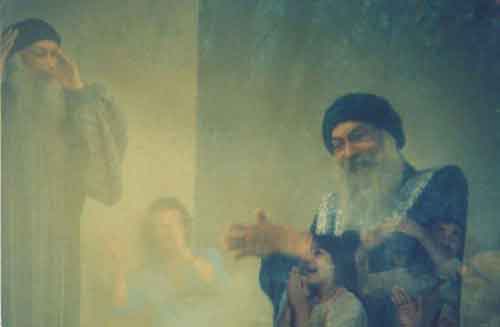
As any devoted person to the search for the meaning of life knows and admits, the question of God is central. The decision to accept not only the existence of God but his supremacy over the universe is the most significant decision that one can make. Those who reject this conclusion, set themselves up for a man centered cosmos. Logical evidence, intelligent arguments and rational proof are unnecessary, for in the end only belief is needed. All the scientists who ever lived can’t disprove God, while every theologian who ever preached can’t certify his existence to those who are unwilling to believe.
Atheists and agnostics alike, pride themselves on intelligence; their reason. Church goers study their Bible verses, Torah pronouncements and Koran passages. The skeptic often rebuffs these teachings since doctrine is perceived to be the work of men, and not confirmed to be from THE Supreme Being. The post modern world would have you accept that it doesn’t matter what you believe, life is now and will be over shortly. Popular culture regards deep reflection as fruitless, since it is futile to explain the universe. Live for today, in the way you want. That’s the message that dominates the media perception of the world.
Barbara DeConcini - dean of the Atlanta College of Art in Atlanta, Georgia, offers this viewpoint: 19th Century influential cultural critic Matthew Arnold - “drew critical attention to deep concordances between religion and art with their predictions that, in Arnold's famous phrase, "most of what now passes with us for religion will be replaced by poetry." Arnold thought that only art could address his society's widespread loss of confidence in religion, fostered by the rise of modern science. Humankind needed art and especially poetry "to interpret life for us, to console us, to sustain us." If art was canonized, so too was religion aestheticized. In the words of George Santayana, "the whole of Christian doctrine is religious and efficacious only when it becomes poetry."
Contrast what passes for art in today’s video reality coarse society. Any pretense that what you see approaches the artfulness of meaningful human expression has long been discarded. If religion has been discredited, what can be said for the mediums of media degradation and debasement? Not exactly the poetry of Keats, Shelley or Yeats. Could there be a neoteric approach to revive the age old hunger for understanding our own existence?
OSHO was a provocative spiritual teacher from India who established a meditation method as a way to experiment and create the conditions for the birth of a "new man" -- one who is free of all outdated ideologies and doctrines of the past and whose vision encompasses both the spiritual wisdom of the East and the scientific understandings of the West. He taught that “The truly religious people have been simply religious, they have not been dogmatic . . . I don't teach principles, ideologies, dogmas, doctrines. I teach you a religionless religion, I teach you the taste of it. I give you the method to become receptive to the divine. I don't say anything about the divine, I simply tell you "This is the window — open it and you will see the starry night" . . . So my whole effort is existential, not intellectual at all. And the true religion is existential.”
When Ms DeConcini writes: “In mainline Protestantism the theological response to the so-called failure of religion in the modern world took two chief forms: the kerygmatic theology of Karl Barth and the existential or apologetic theology of Paul Tillich. If Barth recalls theology to a radical God-centeredness, Tillich rediscovers its correlative and existential character. With Tillich, theology becomes a way of reformulating and answering the fundamental question of our being, aiming to overcome tendencies toward a rationalized objectivity on the one hand and a romantic subjectivity on the other. Through the method of correlation, the existential questions which arise from our human predicament find response in theological answers derived from revelation”, she is illustrating a technique that bridges the gap that is missing in the modern world.
Materialism, that worships science as almighty, has not been able to substitute itself for a creator; even though it tries. While men seek to uncover the working of Human Genome and the secrets of DNA, it has only produced an empty society, lost and disturbed. The insight of Tillich incorporates a form of spiritualism that the eastern mysticism of OSHO could appreciate. That window must raise the shades and open the panes and learn how to become receptive. So when DeConcini asserts, that the “interdependence of the existential question and the theological answer is "the universal principle of revelation in religion and culture" and as such their one theonomous root; we should not dismiss as being irrational. If she is correct that “the void that Tillich sees as the cultural destiny of the modern period can be viewed theologically as a sacred void, an existential cry of ultimate concern”, then we have a slim chance to resurrect ourselves, with a renewed faith in the eternal.
The art of the faith is to accept the belief as true. Science confirms not the doctrine, but the revelation. There is no axiomatic conflict, science does not empirically dispel the essential. But the religion of the absolute, secular scientist, lacks the art of humility. The law they reject as superstition, is the solution they are unable to discover. Why is it so abstruse to admit the self-evident? The art of religion is the willingness to seek the light that shines through that window. Salvation is not found in clerics or churches, but only exists as a gift. The thought of the unrestrained apostasy of the modern age for a biblical faith in the God of divine manifestation, is too much for the sophisticated intellectual.
No, their answer is to perfect the social environment without improving the human condition. They deny that human nature rejects perfectibility, as a social project. Religious meaning comes with faith in the only rule that matters. Faith is a living, bold trust in God's grace; so says a familiar name. Is it just as true today as when it was first stated? Karl Barth would recognize the preacher, but the question is would you? (click on the faith link and test your belief) But in the end, his is just another ministry of man. The meaning in his spiritual revolution essentially lies in your willingness to seek and allow that which you alone, are unable to comprehend, to enter your soul. The mystery is hidden from our abilities, but our faith unites us with the divine. OSHO’s “new man” is not new. He is the same as all men. His purpose is a union with God, by faith and obedience to His law. The Existential experience is a process that helps to open that window. The choice is yours - you are condemned to be free . . .
SARTRE - December 16, 2003
posted by SARTRE ! at
12/15/2003 |

![[Valid RSS]](http://pages.zdnet.com/sartre/sitebuildercontent/sitebuilderpictures/valid-rss-antipixelA.jpg "Validate my RSS feed")
© Copywrite 2002-2004: Another BATR
Site

A BATR Site open for public posting on philosophical topics. Existentialism offers a path for self realization and forward thinking. Thoughtful critiques on the human experience - Paleo Politics for the real world. Now seeking original thinkers with the talent to express insights. Register with Blogger and publish your work on Existentialism Philosophy. Request an invite from SARTRE.
Philosophy Resources


Featured Sites
D. Anthony Storm's Commentary On Kierkegaard
|
|
Radical Academy Powered by: BATR Links
Radical Academy

Breaking All
The Rules
BATR News
Solitary Purdah
Existentialism
- BATR
Metaphysics
- HOPE
Old Right News
Old Right Pundits


